
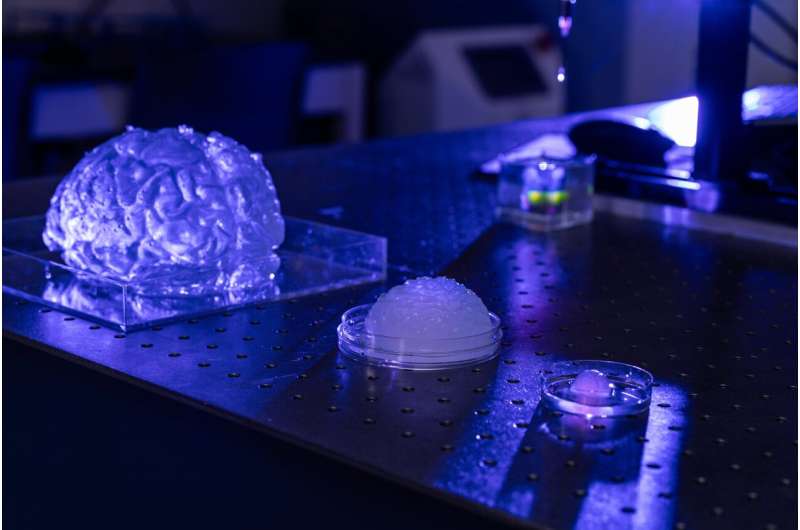
Novel to their approach, these 3D models not only look and feel like real tissue but also behave like it, opening the door to safer training, more precise research and advances in personalized medicine. Researchers have already printed a small-scale model, about 15% of the brain’s actual size, and are working toward creating a full-sized version within the next year.
Traditional methods for creating these soft tissue models often result in a reproduction that’s uniform in structure—making it challenging to replicate the variation in stiffness and texture of real human organs. To overcome this challenge, Mizzou’s scientists are using a technique called embedded 3D printing.