
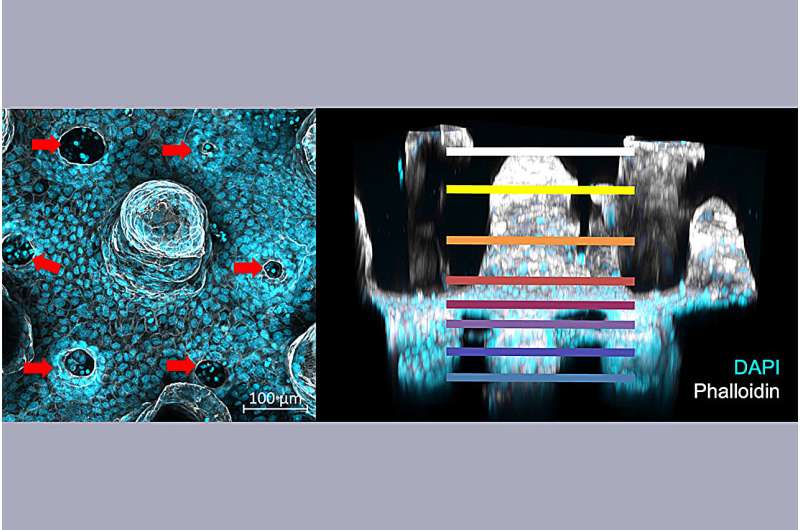
Now, we are poised to learn much more about the gut and its pivotal role, thanks to an advance by a team of researchers at Lawrence Livermore National Laboratory (LLNL). They replicated the gut in three dimensions, with all its spectacular architecture and activity, on a fluidic chip the size of a microscope slide.
The results are described in a paper, “Development of a gut-on-a-chip microfluidic device with three-dimensionally printed human intestinal tissue for studying human–microbe interactions,” published recently in Biofabrication.
“The gut is an incredibly complex system, home to trillions of microorganisms, so it’s very difficult to study directly,” said Lindy Jang, the paper’s lead author. “That’s why we developed a simpler research device that mimics the human gut as closely as possible.”