
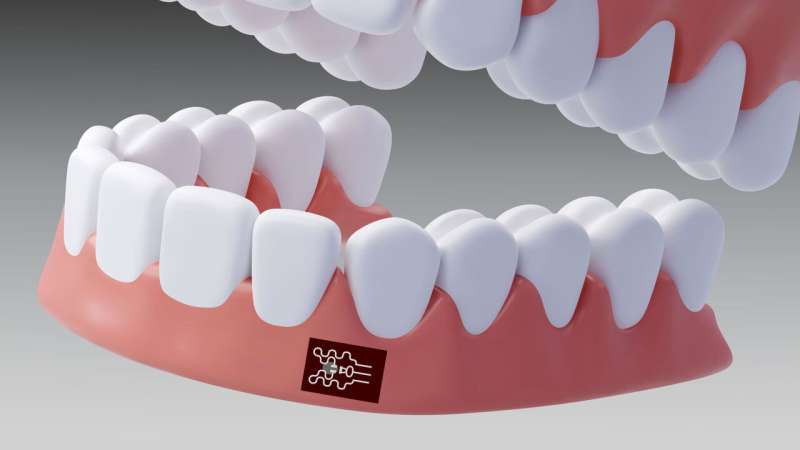
Detecting gum disease currently requires a dentist chair and a visual exam, often catching problems only after tissue damage has started. To shift care from reactive to proactive, researchers at Texas A&M University have engineered a wearable, tissue-adhesive biosensor that detects inflammation biomarkers in the mouth with molecular precision.
The graphene-MXene sensing layer can bind specific probes that attach only to the target protein. The layer has an inherent conductivity, and when molecules such as the targeted protein bind, the change in charge can be measured. This enables highly sensitive detection at the femtogram-per-milliliter (fg/mL) level.
“For context, a patient with a viral infection might show symptoms at 10 million or 1 billion virus copies per milliliter,” Wu said. “Our sensor could detect 100 to 150 per milliliter.”