
Malaria kills 600,000 people each year, mostly children and mostly in the under-resourced countries of Central Africa. Millions more are among the walking infected, unwittingly passing the disease to others through mosquito bites. Faster, more accurate diagnosis would not only improve treatment but identify asymptomatic infections to help control spread of the disease.
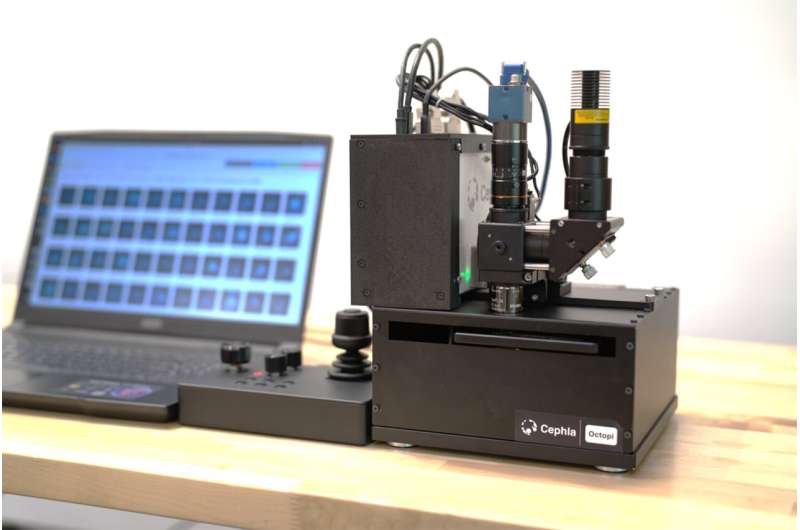
Octopi is remarkably efficient and highly sensitive. It can scan 1 million blood cells per minute—a 100-fold increase in efficiency. And the tool is so sensitive it can spot concentrations of as few as 12 infected cells in a microliter sample of blood with upward of 5 million cells with near-100% specificity.
“Octopi is both fast and precise—but also quantitative,” Prakash said, recalling a time he was in a rural clinic in India where his collaborators were worried that a certain child had cerebral malaria. The team urgently needed to know not only if the child had malaria, but what their exact parasite count was. Octopi was able to deliver that count.