
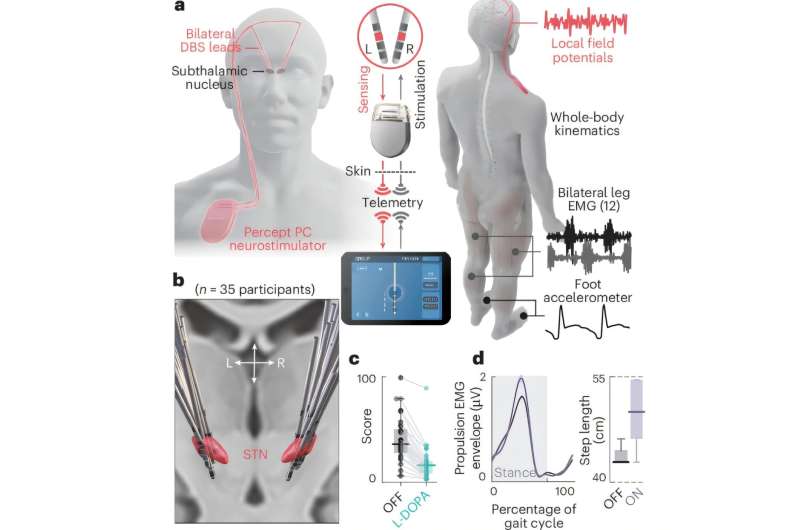
Researchers from EPFL and Lausanne University Hospital (CHUV) have developed a new approach, published in Nature Medicine, that adapts DBS in real time to the patient’s mobility in everyday situations. Thanks to artificial intelligence, the system continuously interprets the patient’s activity and adjusts stimulation in real time, improving walking, climbing stairs and even the simple act of standing up.
Adapting stimulation to real-life situations
“Before, I could barely walk because my legs would feel heavy or sometimes move uncontrollably. Now, as the stimulation adapts to what I’m doing, I can walk better and for longer stretches,” recounts Mr. F, one of the study’s participants. Unlike conventional DBS, which delivers stimulation continuously with fixed parameters, the new therapy adjusts stimulation dynamically based on the patient’s ongoing locomotor activity.