
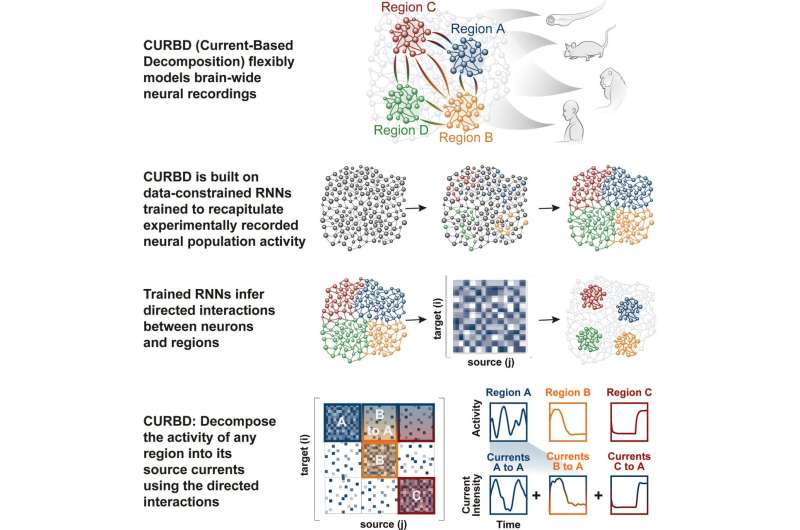
A new artificial intelligence framework called Current-Based Decomposition, or CURBD, can now make that distinction. Developed by Harvard Medical School researchers and their colleagues, the tool is described in Neuron.
“No brain region works on its own. They’re all constantly sending signals to each other, shaping each other’s activity,” said Kanaka Rajan, associate professor of neurobiology in the Blavatnik Institute at Harvard Medical School and the study’s co-senior and corresponding author. “CURBD lets us see those conversations like never before—which region is directing which, and how powerfully.”