
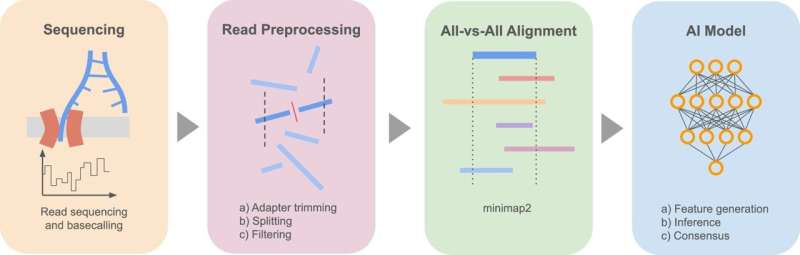
HERRO corrects errors in nanopore sequencing reads generated by Oxford Nanopore Technologies (ONT) sequencers. ONT is a leading player in long-read sequencing, a technology increasingly used when scientists need to read very long stretches of DNA. These long reads help researchers study complex parts of the genome that shorter sequencing reads can find challenging, such as repetitive DNA, centromeres, and the difficult regions of the sex chromosomes.
In this study, the team focused on ONT Simplex reads, which are produced from a single DNA strand and have historically had higher error rates than some other sequencing technologies. HERRO addresses this limitation by using deep learning to correct errors in these reads, improving their accuracy by up to 100-fold. This allows researchers to generate high-quality genome assemblies using a single long-read sequencing platform, instead of relying on more complex workflows that combine multiple technologies. The paper is published in the journal Nature.