
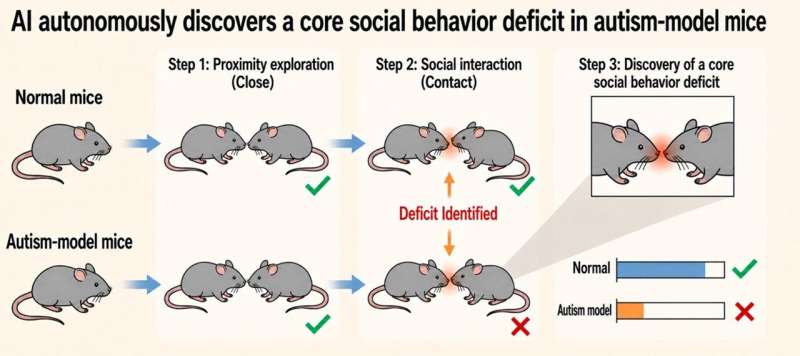
A research team led by Professor Dae-Soo Kim from the Department of Brain and Cognitive Sciences has developed an AI model that interprets animal movements as a form of behavioral language. The study is published in the International Journal of Computer Vision (IJCV).
The researchers transformed skeletal movements of mice into tokens, analogous to words in natural language, and trained a transformer-based model to learn behavioral meaning. The resulting model, named BehaVERT, successfully identified core social behavioral abnormalities in an autism mouse model without being provided any prior biological knowledge.