
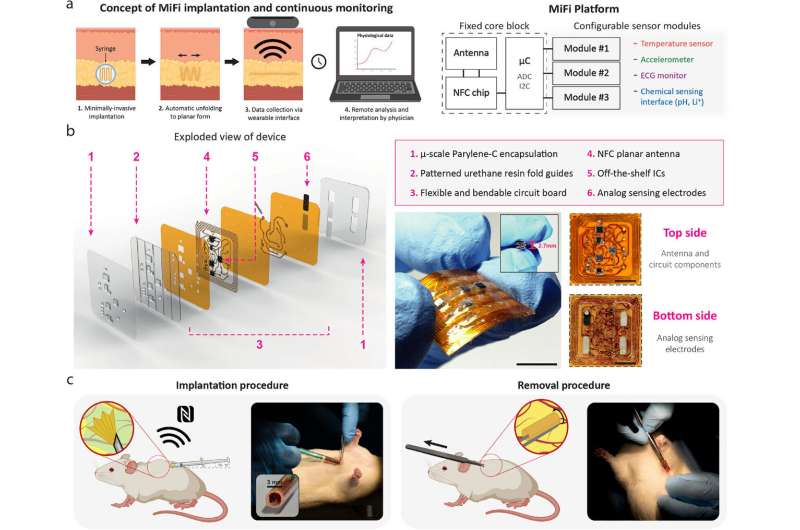
Implants such as continuous glucose monitors or cochlear implants get around this, but they are often bulky, battery-powered or require invasive surgery. Smaller wireless, battery-free devices also have drawbacks, including weaker power links and reduced sensor performance, because they have limited surface areas.
The MiFi (Minimally Invasive Foldable bioelectronic implant), developed by researchers from Imperial College London and the University of Southern California, is designed to overcome these limitations. It is a tiny, origami-inspired implant that is small enough to be inserted without major surgery but large enough to carry wireless power components and multiple sensors.