
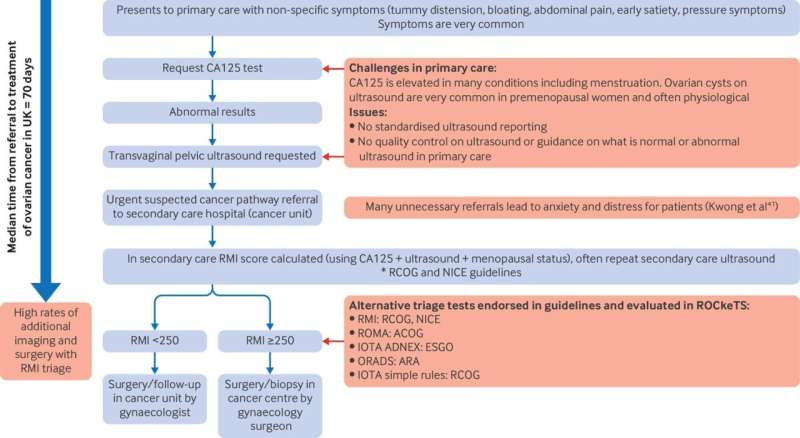
Premenopausal women would benefit from a significantly more accurate diagnostic pathway for ovarian cancer, as a new study finds that an advanced ultrasound test, IOTA ADNEX, identified 9 out of 10 cancers in women who took part. Published in the BMJ, a team led by Professor Sudha Sundar—who conducted the ROCkeTS (Refining Ovarian Cancer Test Accuracy Scores) study—recommends replacing the current NHS triage test, the Risk of Malignancy Index (RMI), because it has low sensitivity for detecting cancer. Researchers found that in younger women, who haven’t been through the menopause, the RMI missed more than half of the cancers.
The new study suggested that the IOTA ADNEX ultrasound model offers far higher sensitivity, but slightly lower specificity: while this may lead to more women undergoing additional tests to exclude cancer, it represents a significantly more effective approach for detecting cancer earlier and improving patient outcomes.