
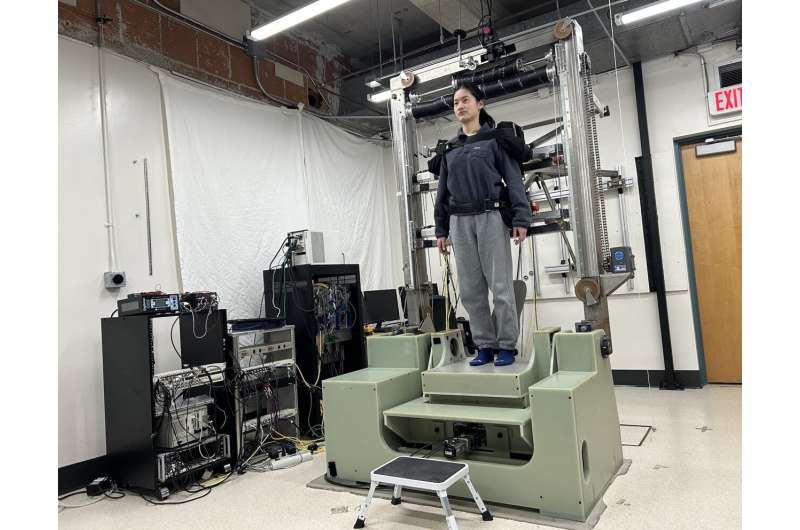
A towering “body-swap” robot built by University of British Columbia researchers is giving scientists an unprecedented look at how the brain keeps us standing—a skill we barely notice until affected by age or disease.
Their findings, published today in Science Robotics with collaborators at Erasmus Medical Clinic, reveal that to stay balanced, the brain treats delays in sensory feedback almost the same way it handles changes in body mechanics. In other words, when it comes to balance, our sense of space and time appears to work from the same playbook.
“What’s exciting is that this opens the door to new practical applications,” said Dr. Jean-Sébastien Blouin, senior author and professor in UBC’s School of Kinesiology. “If we understand how the brain copes with delays and mechanical changes, we can design assistive devices or rehab strategies for older adults and even build robots that move more like us.”