
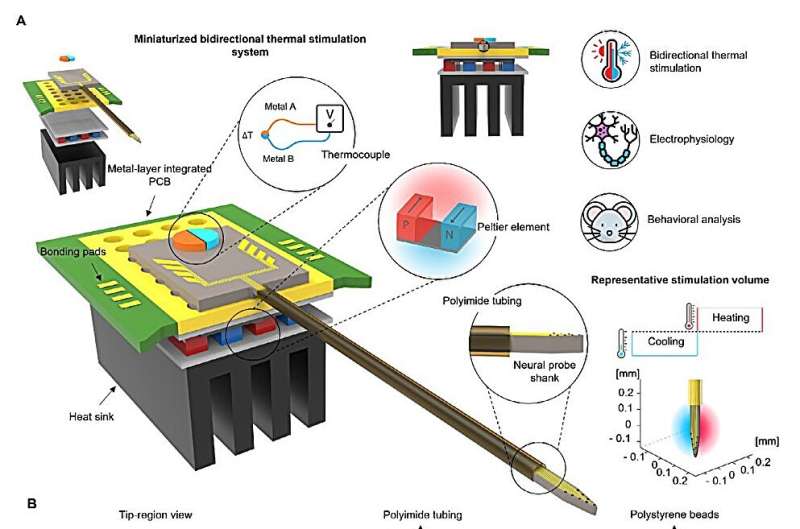
Current neuromodulation technologies primarily rely on electrical, magnetic, optical, ultrasonic or chemical stimulation. However, many existing approaches are designed either to activate or suppress neural activity in a single direction, limiting their ability to achieve precise, bidirectional control of neural circuits.
Temperature, by contrast, is a physiological factor capable of both increasing and decreasing neuronal activity. This unique characteristic enables both activation and inhibition through a single mode of stimulation. Despite its potential, the practical application of temperature-based neuromodulation has been constrained by the technical difficulty of delivering localized cooling and heating to deep-brain regions.