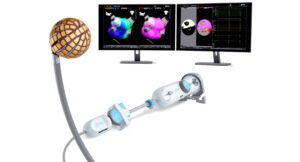
Wireless neural interface could be used for drug delivery to deep brain regions
A research team has developed an implantable wireless neural interface capable of delivering drugs precisely to deep regions of the brain.

A research team has developed an implantable wireless neural interface capable of delivering drugs precisely to deep regions of the brain.

Post-traumatic stress disorder (PTSD) is a mental health disorder triggered by traumatic experiences such as accidents, disasters, or violence. Exposure therapy, a scientifically validated treatment for PTSD, involves the gradual re-exposure of patients to trauma-related cues to reduce anxiety and avoidance behaviors.

Researchers at University of Tsukuba have demonstrated for the first time that brain regions responsible for high-level motor planning and preparation, such as the premotor cortex, are activated when a cyborg-type robot is volitionally controlled.

The NHS announced a first-of-its-kind initiative in England, offering automated insulin delivery systems for pregnant women with diabetes.

Pulse Biosciences (Nasdaq:PLSE) announced today that the FDA granted investigational device exemption (IDE) for its nanosecond pulsed field ablation (nsPFA) system.

Lifeward (Nasdaq:LFWD) announced today that it received CE mark approval for its ReWalk 7 personal exoskeleton.

In the depths of the ocean, marine corals have evolved intricate, porous structures that shelter diverse microbial communities. Now, researchers have borrowed this biological blueprint to create an ingestible pill that can sample bacteria from one of the most inaccessible regions of the human body: the small intestine.

Sepsis arises from infection and immune dysregulation. Neutrophils play a key role in its progression, yet existing clinical tools cannot simultaneously isolate these cells and measure their functional activity.

Scientists have developed a tool made from a modified glue gun that can 3D print bone grafts directly onto fractures and defects during surgery.

An ultrasound device that can precisely stimulate areas deep in the brain without surgery has been developed by researchers from UCL and the University of Oxford, opening up new possibilities for neurological research and treatment of disorders such as Parkinson’s disease.