
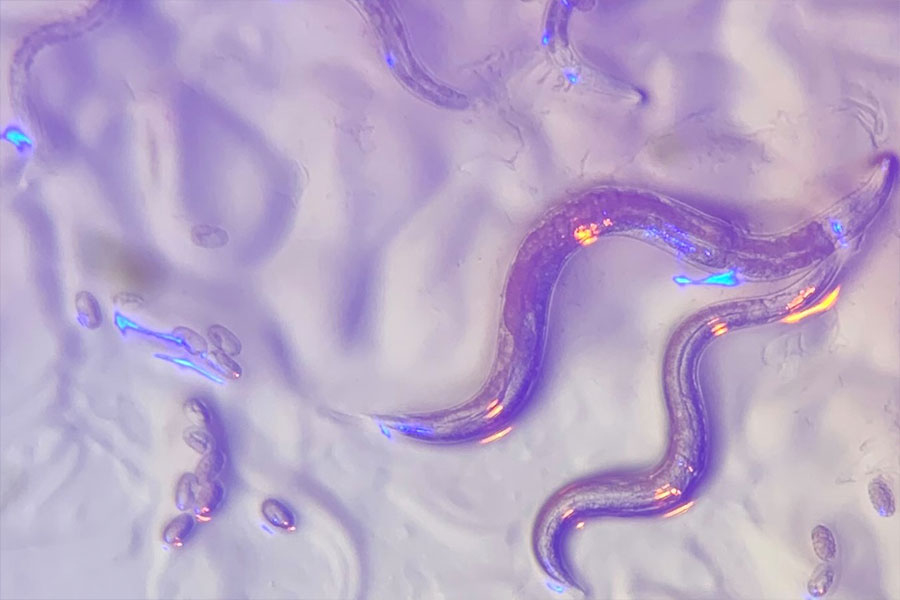
For decades, scientists with big questions about biology have found answers in a tiny worm. That worm — a millimeter-long creature called Caenorhabditis elegans — has helped researchers uncover fundamental features of how cells and organisms work. The impact of that work is enormous: Discoveries made using C. elegans have been recognized with four Nobel Prizes and have led to the development of new treatments for human disease.
In a perspective piece published in the November 2025 issue of the journal PNAS, 11 biologists including Robert Horvitz, the David H. Koch (1962) Professor of Biology at MIT, celebrate Nobel Prize-winning advances made through research in C. elegans. The authors discuss how that work has led to advances for human health, and highlight how a uniquely collaborative community among worm researchers has fueled the field.