
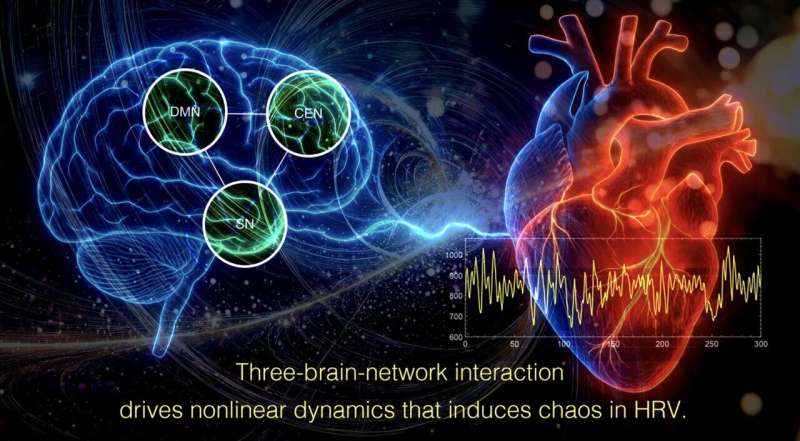
HRV is widely used as an indicator of autonomic nervous system function. However, its ability to reflect higher-order brain activity has remained unclear. In this study, the researchers applied nonlinear analysis and chaos theory to examine heartbeat dynamics under cognitive load.
The researchers had participants perform cognitive tasks designed to engage higher-order brain functions. They then analyzed heartbeat signals using both conventional HRV indices—such as time-domain and frequency-domain measures—and chaos-based metrics derived from nonlinear dynamics. The research is published in the journal Scientific Reports.