
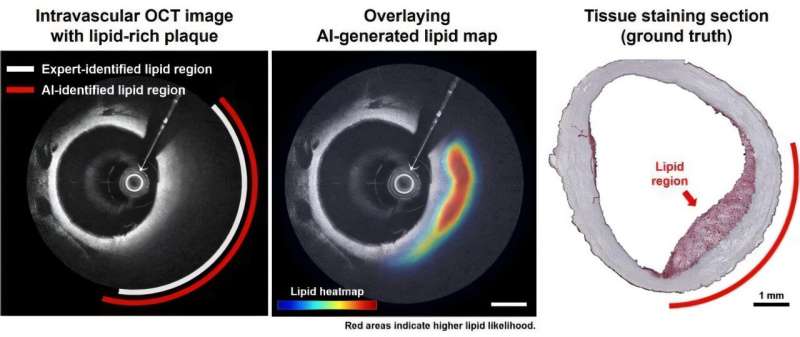
OCT is used during catheter-based procedures such as those used to open partially blocked blood vessels and place stents to help blood flow more freely. Although OCT provides very detailed images of the vessel structure, standard OCT images don’t reveal the composition of the vessel wall, which is important for assessing heart attack risk.
“Plaques with more lipid and certain patterns of lipid distribution are strongly associated with the risk of major cardiac events,” said research team leader Hyeong Soo Nam from Korea Advanced Institute of Science and Technology in South Korea. “By analyzing wavelength-dependent information hidden in the OCT signal and combining it with AI, we were able to identify the presence and distribution of lipid within the vessel wall.”