
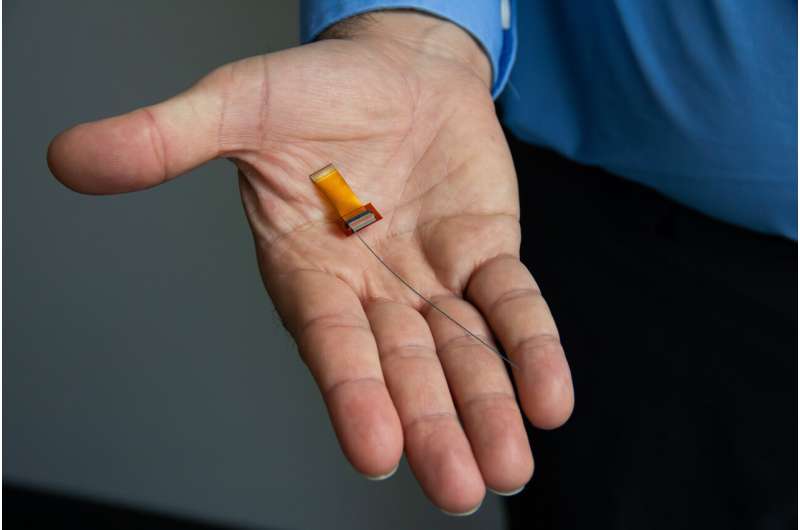
Now, Carnegie Mellon engineering researchers have fabricated the first stainless steel neural probe that allows for customizable, high-density neural recording, making brain readings much safer than before.
The team’s work is published in the journal Nature Communications.
Over the last few decades, novel manufacturing and microfabrication processes have revolutionized neural probe technology. Based in large part on the adaptation of silicon as the material of choice, it has been possible to increase recording channel density using high resolution lithography and microfabrication processes, and to add new functionalities such as optical stimulation and imaging and chemical sensing.
While existing silicon probes work well in thin, shallow tissue, its brittleness limits deep brain maneuvering. By creating probes made out of stainless steel, researchers are able to navigate to the middle brain with minimal cortical tissue damage, enabling inter- and intraoperative neural recording for epilepsy localization and deep-brain-stimulation implantation.