
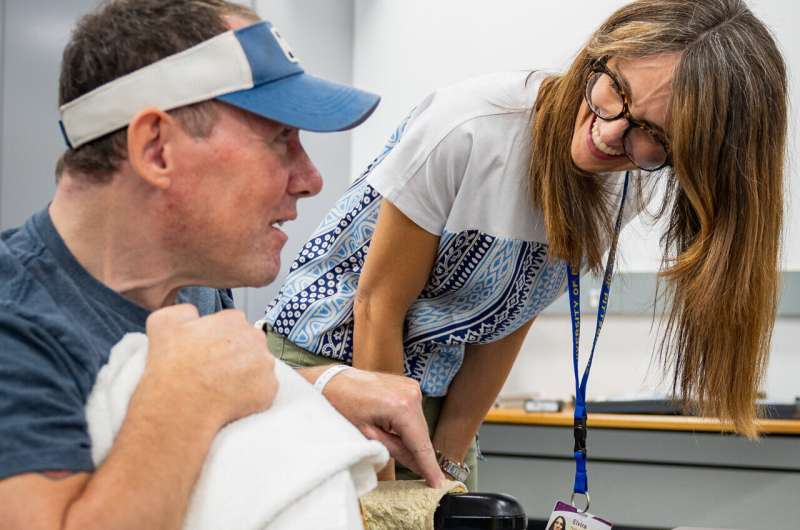
The proof-of-concept study found that low-frequency electrical stimulation of the motor thalamus, a deep brain region connected to the motor cortex, improved control of facial and tongue muscles involved in speaking and swallowing. The findings suggest that DBS may be able to strengthen remaining communication pathways between the brain and muscles after TBI, with the potential to improve and partially restore a person’s ability to communicate verbally.
The study, led by Elvira Pirondini, Ph.D., assistant professor of physical medicine and rehabilitation at Pitt’s Rehab Neural Engineering Laboratory, and Jorge A. Gonzalez-Martinez, M.D., Ph.D., professor of neurological surgery at Pitt, builds on the group’s previous work using neuromodulation to improve arm and hand movement after brain injury.