
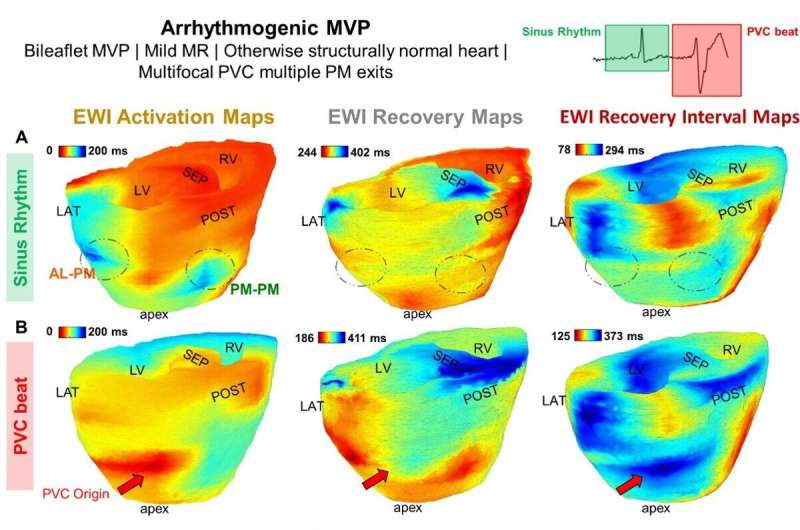
Years after the development of Electromechanical Wave Imaging (EWI), Elisa Konofagou, the Robert and Margaret Hariri Professor of Biomedical Engineering at Columbia Engineering, has been developing techniques to capture electrical activity and mechanical motion within the heart based on cardiac ultrasound images called echocardiograms.
In a new study published in the journal Proceedings of the National Academy of Sciences, Konofagou and her team, in collaboration with Columbia NYP Pediatric Cardiology and the Institute of Cardiovascular Sciences at University College London, UK, found that patients with MVP had significantly delayed electromechanical activation of the left ventricle, particularly near the papillary muscles, which ensure proper closure of the valve as the heart pumps blood.