
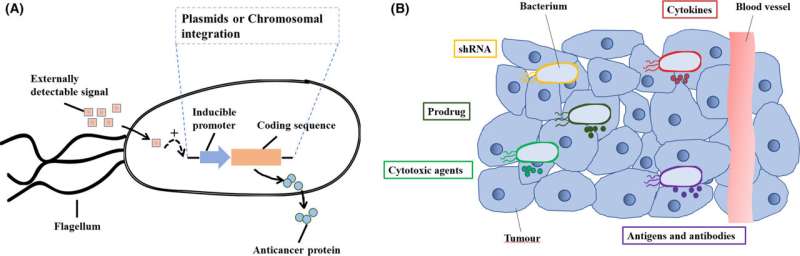
Every year, millions of people are diagnosed with cancer globally; however, current treatments are limited by disease complexity. A study published in the open-access journal in PLOS Biology by Tianyu Jiang at Shandong University, Qingdao, China and colleagues suggests that Escherichia coli Nissle 1917 (EcN) may be engineered with anticancer agents to treat cancerous tumors in mice.
Bacteria inhabit and interact with the human body, playing a major role in both health and disease. However, the therapeutic efficacy of engineered bacteria-based cancer therapies has not yet been established.