
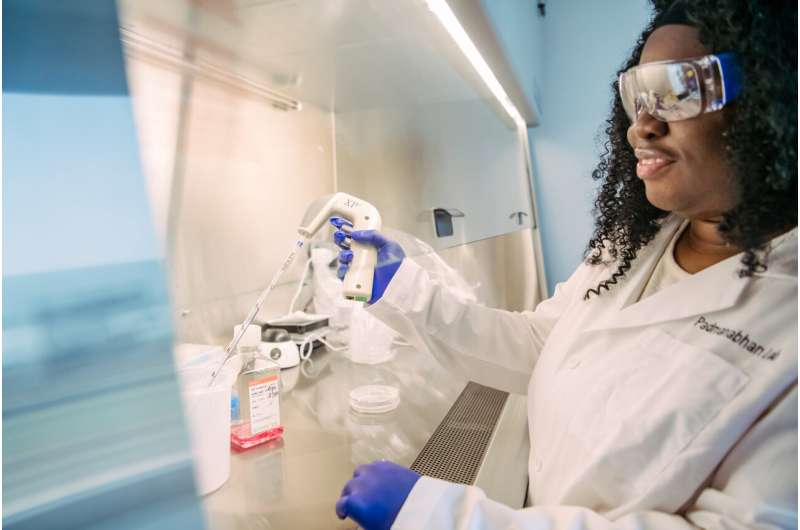
New research from Achuth Padmanabhan’s lab at the University of Maryland, Baltimore County (UMBC), offers hope in the form of a potential molecular target for new cancer drugs: an enzyme called USP15, which ovarian cancer cells appear to rely on more heavily than normal cells.
Biological sciences Ph.D. student Ayokunnumi “Ayo” Ogunsanya led the work, which included experiments in cells and in mice. The results show that lowering USP15 levels causes a constellation of effects that make it a prime target for new treatments: It slows cancer-cell growth, prevents chromosomes in cancer cells from separating cleanly during division (leading to DNA damage and cell death), reduces the cells’ ability to migrate and invade other tissues, and makes them more sensitive to common chemotherapy drugs.