
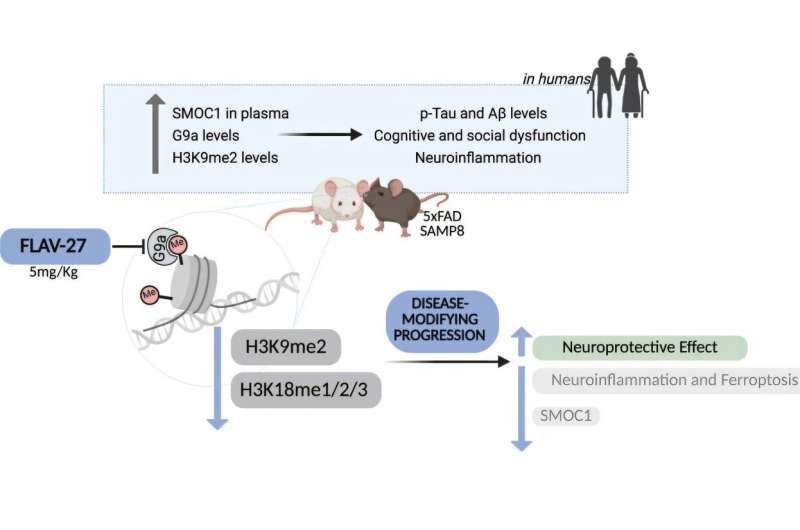
The results of this study, published in Molecular Therapy, open the door to an epigenetic-based therapeutic strategy to fight Alzheimer’s disease.
“The compound FLAV-27 represents an innovative and promising approach to Alzheimer’s disease, with the potential to modify the disease process, as it acts not only on its symptoms or a single pathological biomarker, but directly on its underlying molecular mechanisms,” says Aina Bellver, a researcher at the UB Institute of Neurosciences (UBneuro) and first author of the paper.
The study was led by Professor Christian Griñán and Professor Mercè Pallàs, from the Faculty of Pharmacy and Food Sciences, with the participation of researchers from UBneuro and the CIBER Area for Neurodegenerative Diseases (CIBERNED), as well as the UB Institute of Biomedicine (IBUB), the Institute of Nutrition and Food Safety (INSA-UB), the August Pi i Sunyer Biomedical Research Institute (IDIBAPS) and other national and international institutions.