
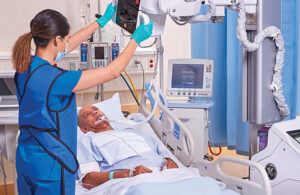
Part of the company’s Critical Care Suite 3.0 software, the agency’s green light also extends the AI platform’s use to pediatric patients for the first time.
Mobile X-ray machines are commonly used in emergency rooms and intensive care units, where many patients also receive nutrition through nasogastric or nasoenteric tubes. By hosting the AI on the scanner itself, clinicians can obtain fast guidance without relying on internet or cloud connections.
The program can automatically identify a tube’s path, as well as its tip and side ports, and highlight the patient’s airway and diaphragm to ensure proper placement. Pediatric anatomy also requires special considerations.