
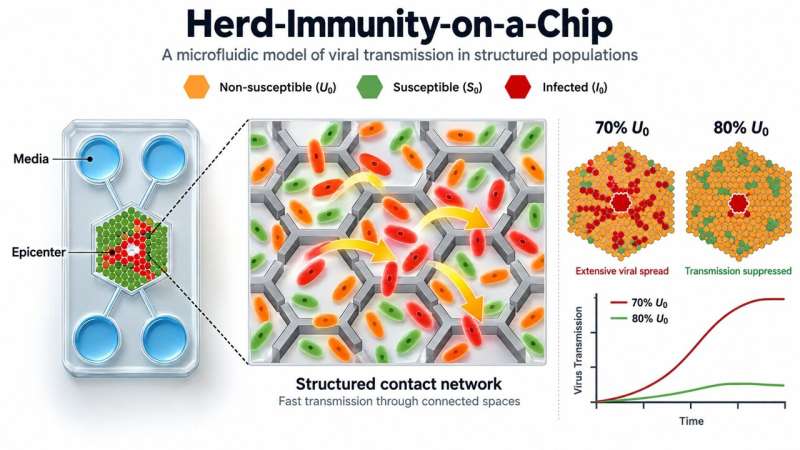
The study moves beyond conventional cell-infection assays by treating the chip as a simplified society. In this design, lung fibroblast cells act as individuals, hexagonal microchambers serve as spatially organized social spaces, and interconnecting microchannels function as controllable contact routes between those spaces.
This configuration allowed the researchers to observe, in real time, how infection spreads—or fails to spread—through a structured population.
The limits of uniform mixing
Until now, the spread of infectious diseases and the level of population immunity needed to suppress transmission have been studied largely through epidemiological observations, mathematical models and computer simulations.