
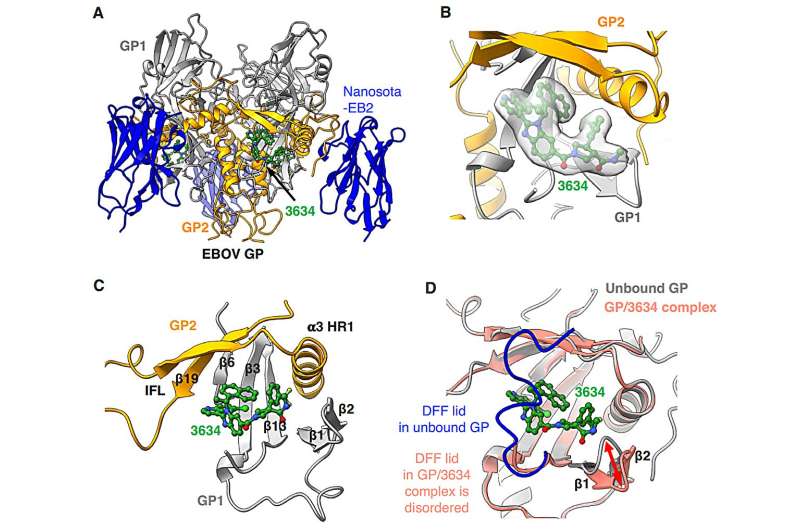
The study, recently published in Nature Communications, resulted from extensive collaboration among the University of Minnesota, Baylor College of Medicine, Boston University and the University of Florida Scripps Institute, with support from the Midwest Antiviral Drug Discovery (AViDD) Center, based at the University of Minnesota.
MWAC-3634 targets the Ebola virus entry protein. All previously structurally characterized small molecules targeting this protein destabilized it. MWAC-3634 instead stabilizes the entry protein, preventing the shape changes required for viral entry. It is also at least 100 times more potent than previously reported small-molecule Ebola entry inhibitors.