
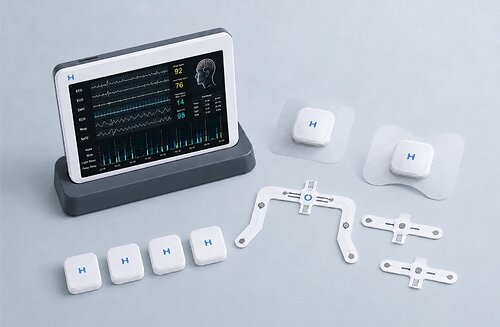
Polysomnography (PSG) is the standard diagnostic test for sleep disorders such as sleep apnea. Conventional PSG, however, generally requires patients to spend a night at a hospital while connected to more than 24 wired sensors placed across the face, chest, abdomen and legs. The complex setup and restricted movement can cause considerable discomfort. Sleeping in an unfamiliar clinical environment may also affect patients’ usual sleep patterns, potentially making it more difficult to capture representative data.
To overcome these limitations, HoneyNaps redesigned the conventional PSG measurement architecture. Its Wireless PSG system consists of four compact skin patches: a Head Sensor, Chest Sensor, Body Sensor and Leg Sensor. Together, they consolidate the functions previously performed by numerous wired sensors into a single wearable platform.