
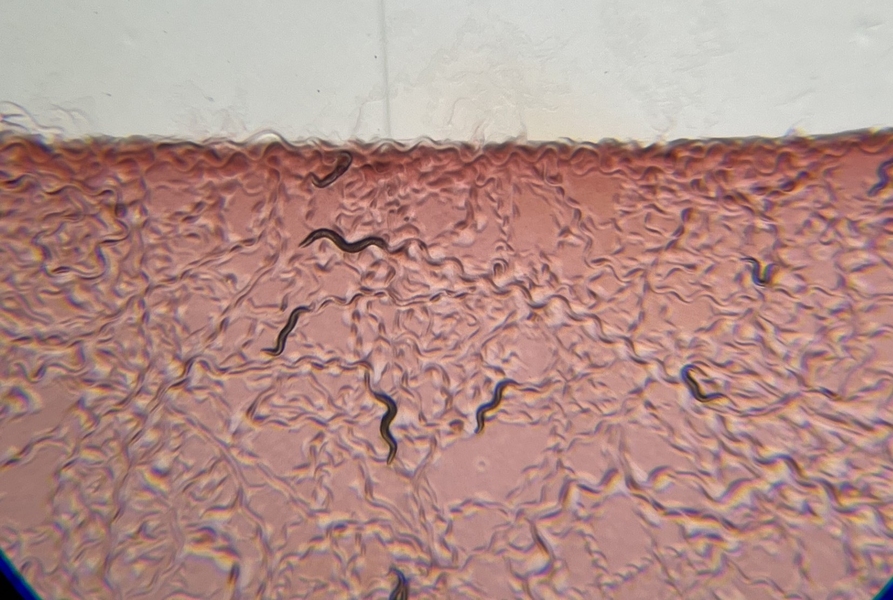
Recent studies suggest animals and people alike have close and complex relationships with the bacteria around and within them. The human gut microbiome, for instance, has been associated with both depression and Parkinson’s disease. To go beyond association toward understanding of the actual mechanisms that enable the bacterial microbiome to influence brain function, a new study by neuroscientists in The Picower Institute for Learning and Memory at MIT examines the mechanisms at work in a model “bacterial specialist,” the nematode Caenorhabditis elegans.
In the new open-access study in Current Biology, the team, led by Picower Fellow Cassi Estrem in the Picower Institute for Learning and Memory lab of Associate Professor Steven Flavell, identifies the specific chemicals that a key neuron in C. elegans senses, both in the bacteria that it eats and in the bacteria that it needs to avoid ingesting.