
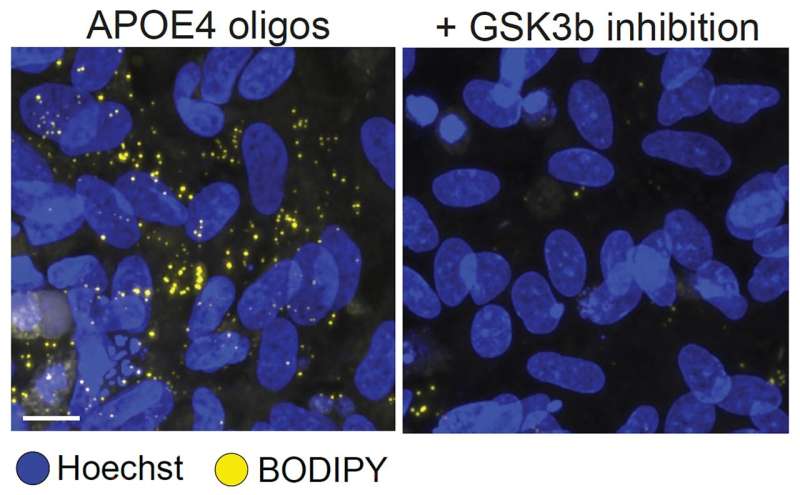
A new study led by neuroscientists at The Picower Institute for Learning and Memory at MIT provides several lines of evidence to implicate a specific molecular pathway in that disruption and uses that insight to demonstrate an intervention for preventing it in lab experiments.
The study published in Cell Stem Cell shows that APOE4 leads to a suppression of “Wnt” signaling in the oligodendrocyte cells that provide neurons with a fatty insulation, called myelin. When Wnt signaling is deficient, they showed, the cells accumulate droplets of lipids rather than deploying fats to properly myelinate the neurons’ axon branches.