
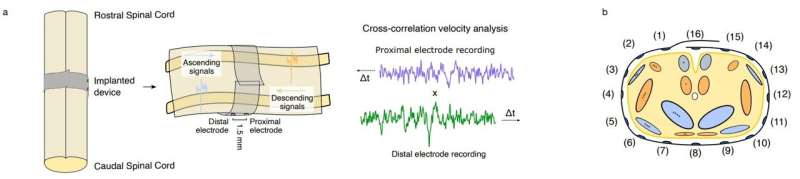
More than 2.5 million people worldwide live with spinal cord injuries. However, therapies to date have largely focused on restoring a single function, such as movement, sensation or autonomic control—until now.
Published in Nature Communications, the study was co-led by Damiano Barone, assistant professor of neurosurgery in the Department of Neurosurgery at Houston Methodist, and George Malliaras, the Prince Professor of Technology in the Department of Engineering at the University of Cambridge.
“Most current technologies try to improve whatever function remains after a spinal cord injury,” Barone said. “Our goal is different. Rather than fixing the injury itself, we want to bypass it completely and create an alternative route for signals to travel.”