
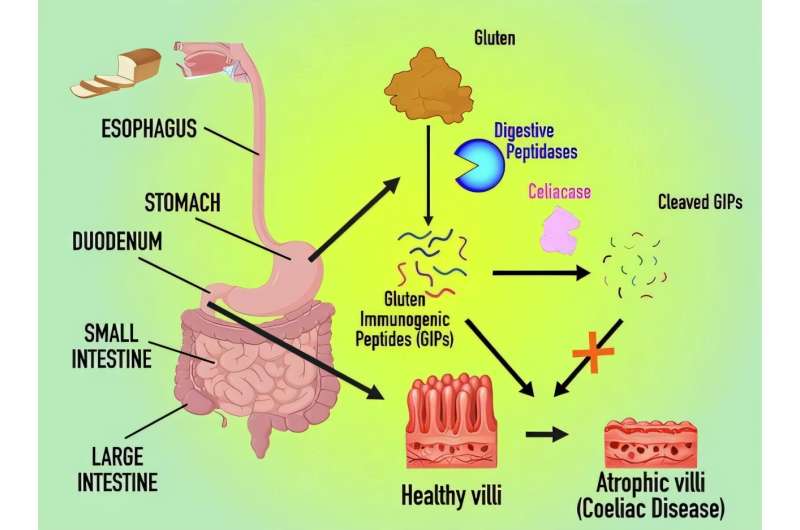
At present, there is a complete lack of treatment options beyond a diet free from gluten, which is difficult to maintain in Western societies where diets rely heavily on wheat products.
The major breakthrough is that the molecule is effective at very low concentrations and at a pH of 2—the pH of the stomach—a condition that none of the molecules currently available or under development had previously achieved with efficiency. Although some of them are marketed as nutritional supplements, they are not an effective alternative to gluten-free diets.
The study has been published in the journal EMBO Molecular Medicine ahead of the International Day of Celiac Disease—which takes place on 16 May—and is led by researchers Francisco J. Pérez-Cano (INSA-UB), and F. Xavier Gomis-Rüth (IBMB-CSIC). The co-first authors are Marina Girbal-González and Arturo Rodríguez-Banqueri (INSA-UB and IBMB-CSIC, respectively). Teams from the Institute for Food Science Research (CSIC-UAM), the University of Salzburg (Austria) and the Technical University of Munich (Germany) have also participated.