
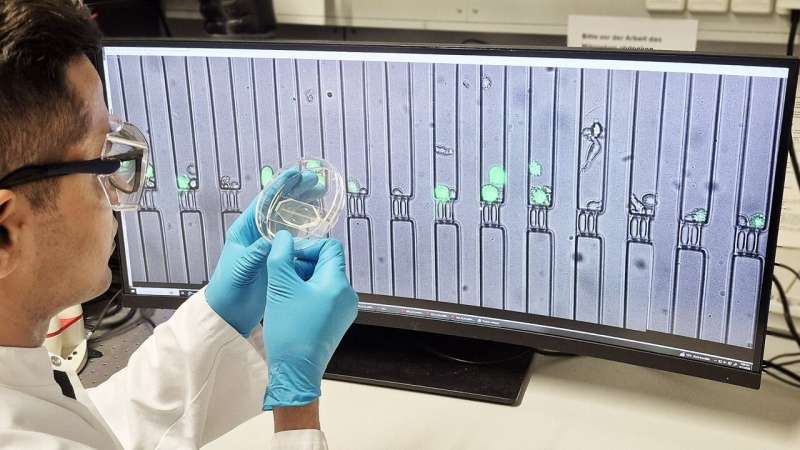
Established laboratory tests mainly capture average values across many cells and show, for example, how many cancer cells survive after contact with immune cells. What happens in detail—how each cell reacts and interacts with others—remains hidden. However, to better understand the effectiveness of immunotherapies, the precise timing of a cell-cell interaction is often crucial: when contact, activation and, ultimately, the killing of the cancer cell occur.
How CellTrap works
CellTrap consists of a microfluidic chip with a large main channel that branches out continuously. At the ends of the branching pathways are 1,024 small trapping chambers into which the cells are drawn. Within the chambers, individual immune cells and cancer cells are selectively brought together, spatially fixed and observed over many hours—up to 14 hours—using a time-lapse microscope. This creates a wide variety of situations: cancer cells alone, immune cells alone or various ratios of immune cells to cancer cells.