
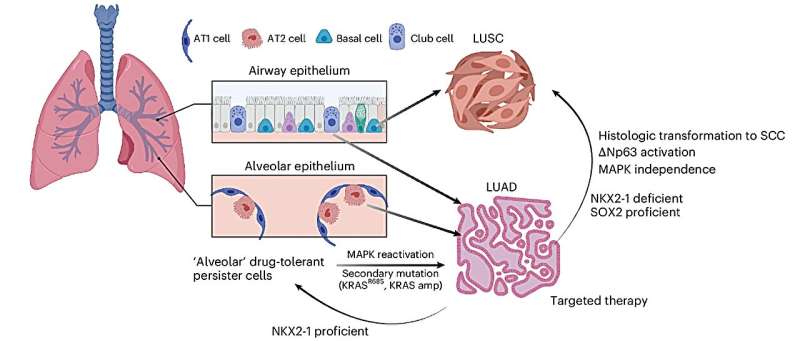
Usually, resistance emerges because cells reactivate KRAS activity through mutations that prevent drug binding or by increasing KRAS expression to overpower the effects of the inhibitor. However, in a new study, MIT researchers have modeled an alternative mechanism that cancer cells can use to become resistant to KRAS inhibition.
The researchers found that in some cases, lung tumors undergo transformation from adenocarcinoma to squamous cell carcinoma. Both of these tumor types are commonly found in the lungs, but they are thought to arise from different cells and have different genetic profiles.