
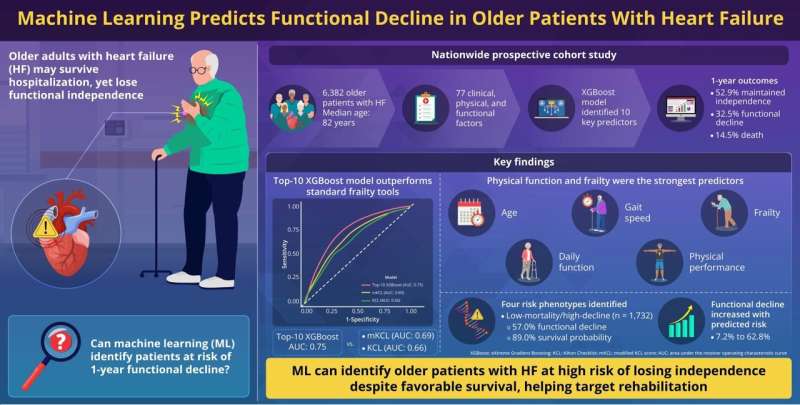
Addressing this challenge, a research team led by assistant professor Kanji Yamada from the Department of Physical Therapy, Faculty of Health Science, Juntendo University, Japan, including associate professor Nobuyuki Kagiyama and specially appointed professor Tetsuya Takahashi, both from the same university, analyzed 6,382 patients aged 65 years or older who were hospitalized for HF, received physical therapy and were independent in activities before admission.
Using the prospective J-Proof HF Registry, they developed an eXtreme Gradient Boosting (XGBoost) model to predict functional maintenance, functional decline or death one year after discharge. The study was published online in the Journal of Cardiac Failure on Aug. 20, 2026.