
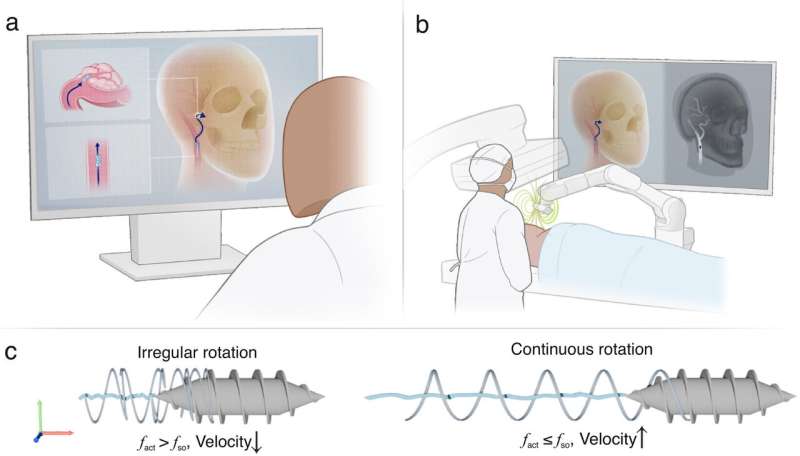
Deep-seated brain lesions, blood clots after a stroke, tumors and vascular malformations are often hard to reach without cutting open the skull. The research team envisions a different route: a robot that travels through the bloodstream, drills through the artery wall at the right spot and continues into the brain tissue to reach the lesion directly.
Predicting when the robot loses control
An external magnet spins the robot, which drills forward like a screw. Spin the magnet faster, and the robot goes faster too, up to a point. Beyond that point, called the step-out frequency, the robot can no longer keep pace. It slips, stalls or moves erratically. The researchers can now predict that moment with a new model.