
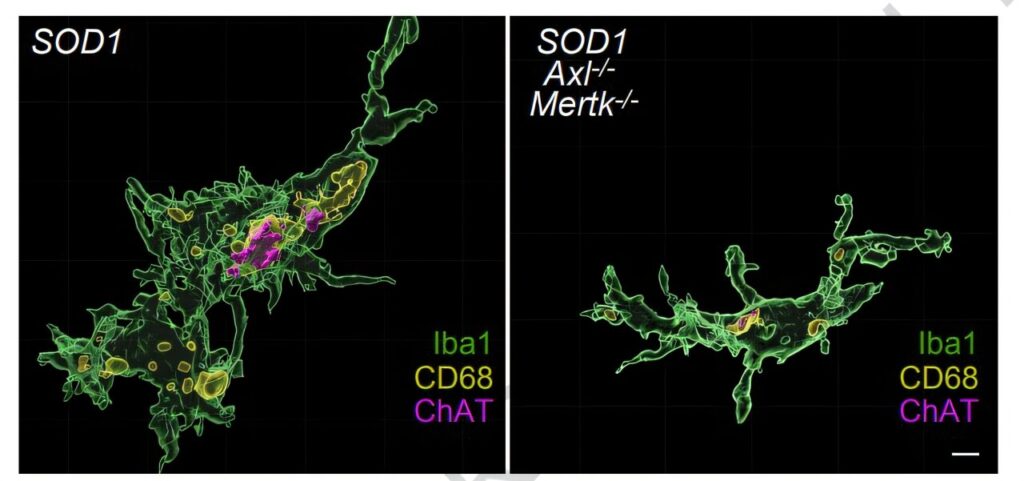
The search for a cure has long focused on movement-controlling nerve cells, or motor neurons, which are progressively lost throughout the disease course to cause ALS’s characteristic muscle and nerve degeneration. But another type of nervous system cell—the resident immune cells in the brain and spinal cord, called microglia—is stepping up to the lab bench.
New Salk Institute research shows a novel way that microglia contribute to ALS progression and death. Microglia use TAM receptors—a class of proteins that facilitate cell destruction and were discovered by senior author Greg Lemke, Ph.D.—to find and kill motor neurons in the spinal cords of mice with ALS.