
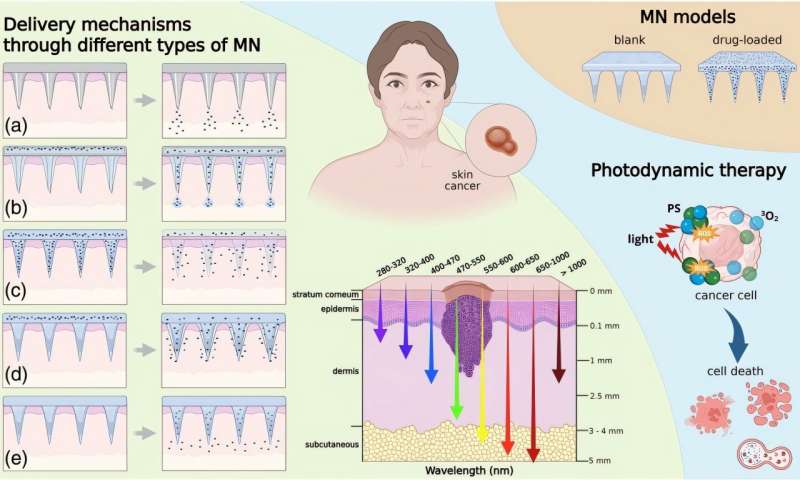
Microneedles are tiny structures, less than a millimeter (0.04 inches) in length, that painlessly pierce the skin’s outer barrier. Made from biodegradable polymers, they gradually dissolve after insertion.
Previous studies by the research group showed that microneedles loaded with aminolevulinic acid (ALA), a drug commonly used in PDT, delivered the treatment more deeply and evenly into skin tumors than traditional creams. This led to a more uniform production of the light-activated compound responsible for killing cancer cells upon light exposure.