
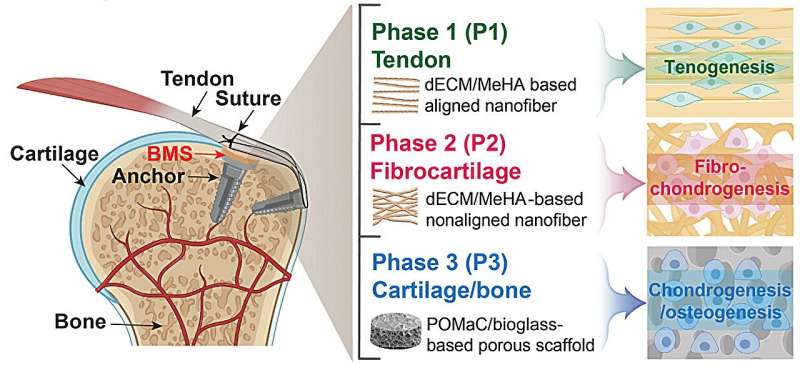
“Successful rotator cuff repair requires more than simply reattaching tendon to bone because the tendon-to-bone interface has a highly organized transition from tendon to fibrocartilage to bone, and each region provides distinct signals that guide how cells behave and what type of tissue they form,” said senior author Su Chin Heo, Ph.D., an assistant professor of orthopedic surgery and bioengineering in the McKay Orthopedic Research Laboratory.
“The body’s cells constantly sense and respond to the physical, mechanical, and biomechanical signals in their surrounding environment. By designing our scaffold to better mimic these different microenvironments, we believe we’re able to provide the right cues in the right places for more complete and effective healing.”