
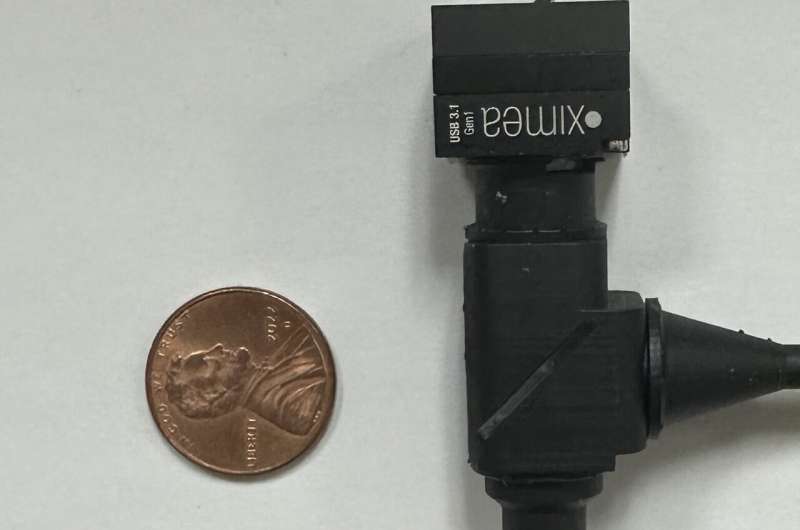
The microscope is designed to image genetically encoded voltage indicators—fluorescent dyes that rapidly change brightness when a neuron fires—through a small window in the skull while the animal is awake.
“Unlike most miniature microscopes that track slower calcium signals, ours captures electrical spikes at hundreds of frames per second,” said Emily Gibson from the University of Colorado Anschutz Medical Campus. “This makes it possible to capture the moment a neuron fires as well as the quieter signals that build up inside neurons before firing.”
In the journal Biomedical Optics Express, the researchers describe the new microscope, which is designed to capture very faint changes in brightness. In experiments with mice, they show that it can acquire voltage recordings that closely match those from a standard widefield microscope, reliably measuring activity in individual neurons.