
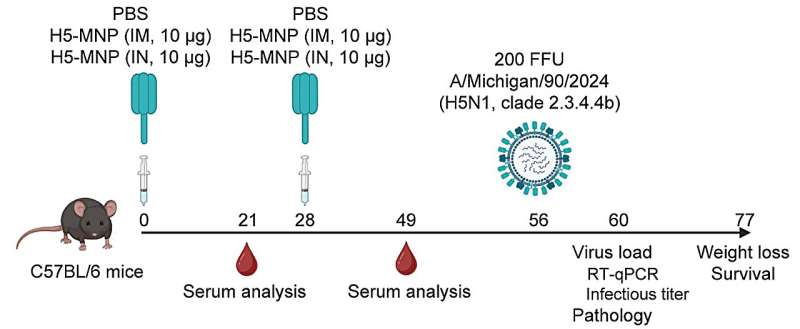
Building on Boon’s prior work on bird flu vaccines delivered nasally, the new study, published July 10 in npj Vaccines, shows that delivering the vaccine to the nose offers better protection against infection in the nose and upper airways than a traditional injection.
The novel vaccine pairs a key protein on the surface of the H5N1 bird flu virus with an immune-boosting ingredient used in some newer COVID-19 and malaria vaccines to prime the immune system to attack this protein. In mice already vaccinated against seasonal flu, a single dose of the H5N1 vaccine generated strong virus-fighting antibodies against the strain of bird flu identified in the 2024 U.S. outbreak, which heavily affected the poultry and dairy industries and caused two human deaths. In contrast, mice with no prior flu exposure required two doses of the new vaccine to achieve the same level of protection.