
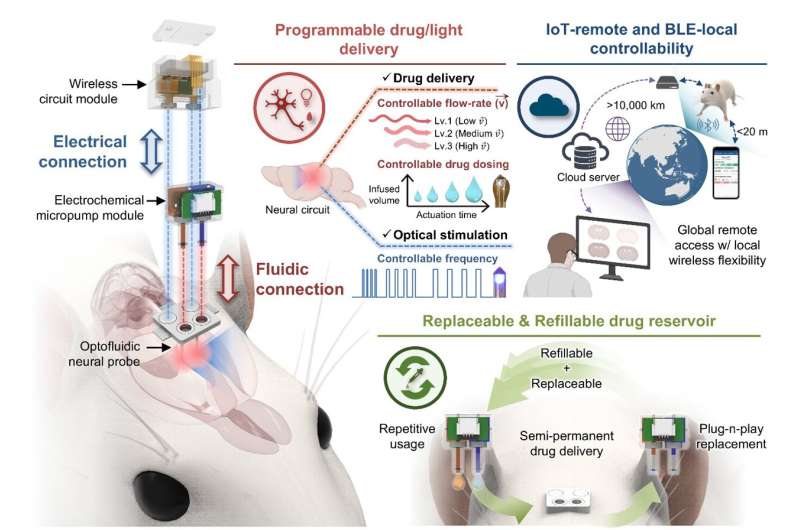
A research team led by Professor Jae-Woong Jeong from the KAIST School of Electrical Engineering, in collaboration with Professor Wha Young Kim’s team at Yonsei University College of Medicine, has developed an IoT-enabled wireless neural implant that integrates drug delivery, optical stimulation, wireless communication and internet-based remote control into a single miniaturized device.
The research is published in the journal Science Advances.
Removing the lab-side constraint
Conventional studies involving optical stimulation or drug delivery to the brain often required bulky equipment connected by wires, restricting the natural movement of experimental animals. Even wireless devices had their own limitations, often requiring researchers to operate them at close range, thereby restricting experimental flexibility and introducing the so-called “observer effect.”