
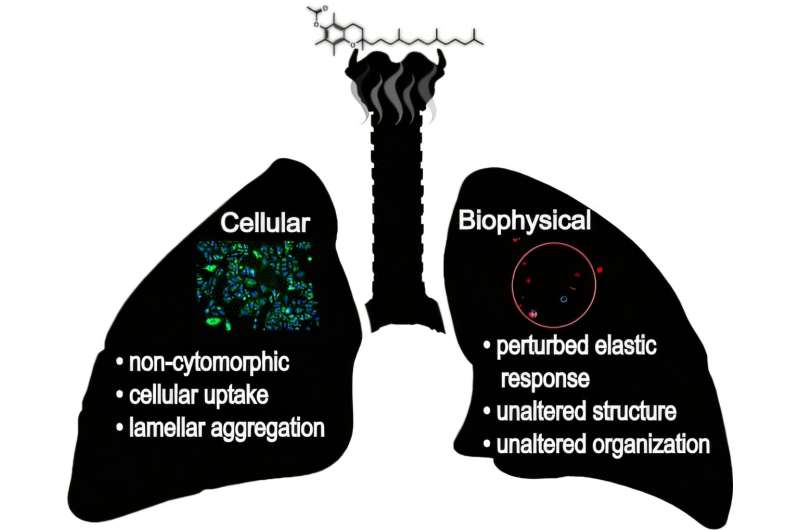
Lead researcher Drew Marquardt and his team used neutron scattering at ORNL’s Spallation Neutron Source and High Flux Isotope Reactor to observe how a commonly used diluent used in many illegal vaping oils, known as vitamin E acetate (VEA), can harm or damage the lungs. The team found that a surplus of VEA collects in the lungs over time, eventually entering the organ’s membrane. This causes the membrane to soften, resulting in the labored breathing associated with EVALI.
The team’s findings are published in Chemical Research in Toxicology.
How neutron scattering aids research
“When physicians first started investigating the uptick of lung injuries in young people, they were finding a buildup of VEA,” said Marquardt. “That meant that the VEA likely had nowhere to go once it entered the lungs. We wanted to better understand what this means for breathing function and how the buildup affects the lungs over time. So, we brought our research to ORNL, where I would put Bio-SANS up against any other SANS instrument in the world in terms of capability.”