
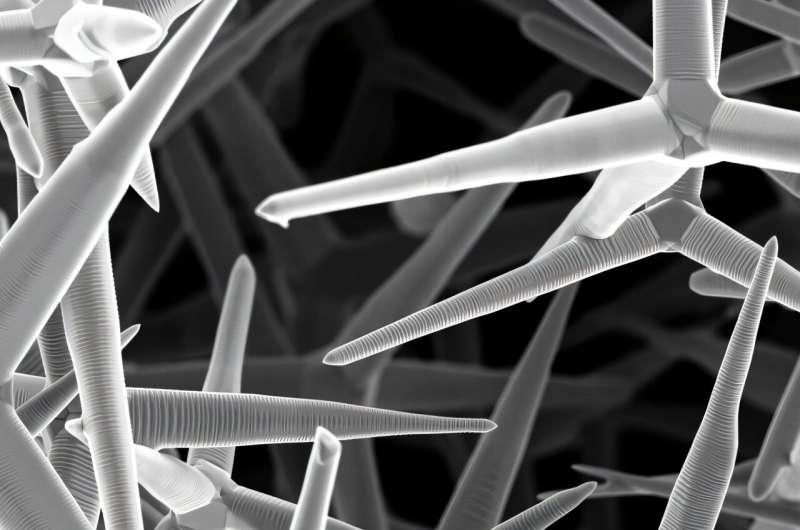
Until now, conventional 3D cell cultures have often been either too rigid or too unstable to realistically reproduce the complex interactions between brain cells.
An interdisciplinary team led by materials scientist Dr. Stefan Schröder from the Faculty of Engineering produced the aerohydrogels—ultralight, hollow-fiber scaffolds that provide astrocytes and microglia with a realistic three-dimensional environment. The team reports its findings in the journal Chem & Bio Engineering, in collaboration with researchers from Harvard Medical School (U.S.) and the University of Oxford (U.K.).
The scaffolds are based on tetrapodal zinc oxide crystals (t-ZnO), which initially form an interconnected 3D skeleton. The team then coated this framework with an ultrathin hydrogel layer using initiated chemical vapor deposition (iCVD). Afterward, the zinc oxide was removed, leaving behind a lightweight hydrogel framework that provides structural support while allowing nutrients and signaling molecules to diffuse through.