
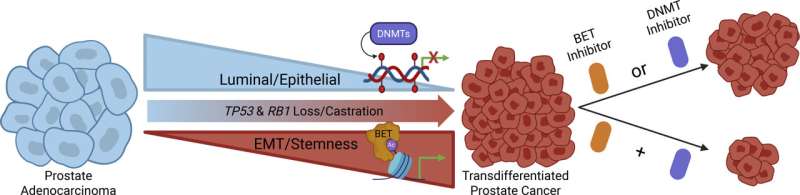
In the United States, prostate cancer is the second-leading cause of cancer-related death in men. Most prostate cancers resemble glands and express glandular genes. They also depend on androgens, male hormones like testosterone, for growth. For this reason, androgen receptor inhibitors are the primary treatment for metastatic prostate cancer.
Although these drugs are initially effective, nearly all patients eventually become resistant to treatment. Some of these resistant tumors adapt by activating different pathways that ultimately change the blueprint of the cells, making them less glandular and allowing them to take on different identities. This process is called transdifferentiation.