
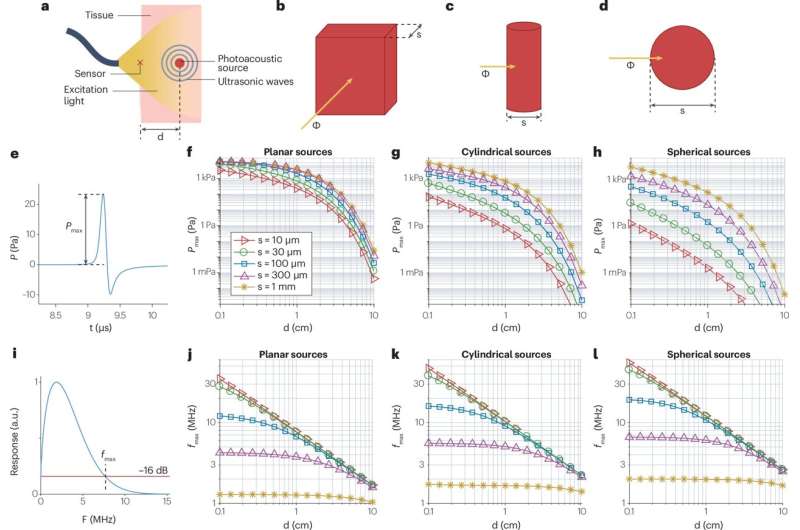
Published in Nature Reviews Methods Primers, researchers at the University of Birmingham and UCL reveal that large ceramic detectors are currently best for deep imaging, while optical ultrasound sensors may be the future for high-resolution imaging of tiny structures.
The authors reviewed published data on 82 ultrasound detectors used in photoacoustic imaging, establishing the first standardized “noise-equivalent pressure” (NEP) landscape—a performance map showing which detectors can hear the faintest biological signals across four main types:
- Ceramic piezoelectric detectors;
- Polymer piezoelectric detectors;
- CMUTs (capacitive ultrasound detectors); and
- Optical ultrasound sensors that detect sound using light rather than electricity.