
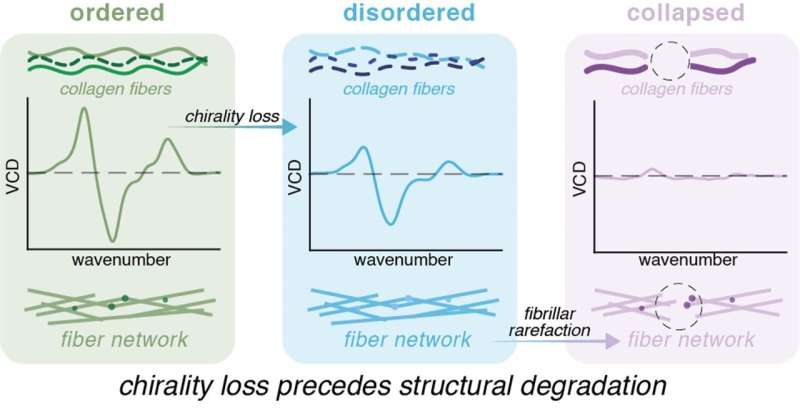
The study, published in ACS Nano, reveals that the molecular organization and supramolecular chirality—or structural handedness—of dermal collagen collapse before the visible fiber network actually thins or fragments.
Collagen is a hierarchical material that forms a highly organized network that supports skin’s structure and mechanical strength. Traditional imaging methods can easily identify visible deterioration, such as fiber thinning or loss of connectivity. However, these structural failures represent late stages of tissue remodeling.
“One way to think about our findings is that conventional imaging methods can show the ‘bricks’ of a collagen structure, but they may miss subtle changes in how those bricks are arranged,” said Ali Haider, first author of the study and a graduate research fellow at Hiroshima University’s International Institute for Sustainability with Knotted Chiral Meta Matter (WPI-SKCM²).