
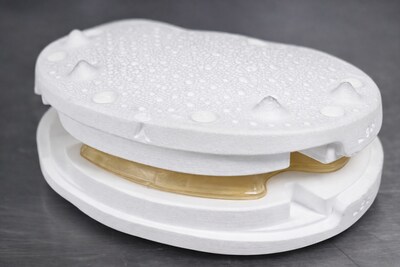
Unlike traditional implants manufactured in fixed sizes and made from metal alloys, Nivalon’s implant is digitally designed directly from each patient’s CT data and 3D printed to precisely match their unique anatomy. The result is a bone-like ceramic structure that eliminates metal-related complications such as corrosion, ion release, stiffness mismatch, and imaging interference, while preserving natural spinal motion.
First-in-human procedures are planned for 2026, including Nivalon’s Co-Founder and CEO, Todd Hodrinsky.
Clinically Validated Through Independent Biomechanical, Mechanical, Biological, and Surgical Testing
The platform has undergone extensive independent pre-clinical validation through biomechanical, mechanical, biological, and anatomical testing conducted at the University of South Florida (USF) and the University of Connecticut Institute of Materials Science (UConn IMS).