
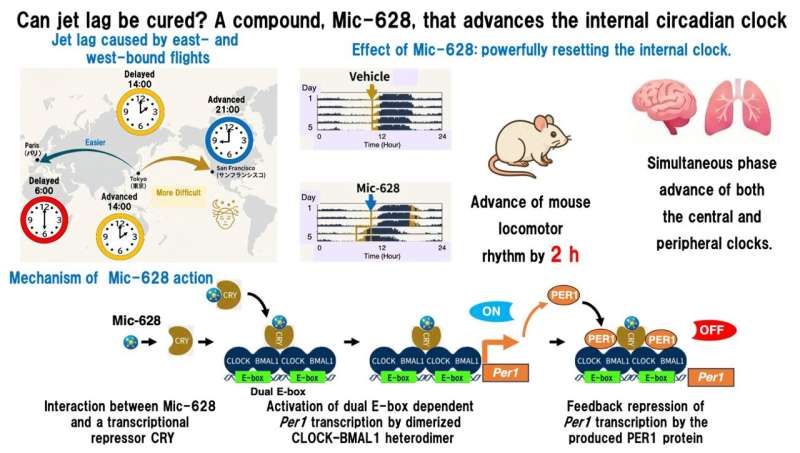
A collaborative team including Emeritus Professor Tei Hajime (Kanazawa University), Associate Professor Takahata Yoshifumi (The University of Osaka), Professor Numano Rika (Toyohashi University of Technology), and Associate Professor Uriu Koichiro (Institute of Science Tokyo), discovered that Mic-628 selectively induces the mammalian clock gene Per1.
Mic-628 works by binding to the repressor protein CRY1, promoting the formation of a CLOCK–BMAL1–CRY1–Mic-628 complex that activates Per1 transcription through a “dual E-box” DNA element. As a result, both the central clock in the brain’s suprachiasmatic nucleus (SCN) and peripheral clocks in tissues such as the lungs were advanced—in tandem and independent of dosing time.