
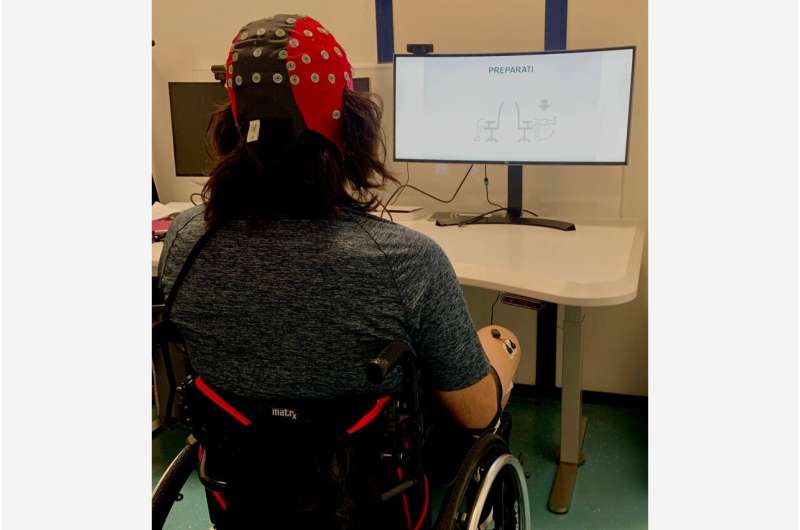
In APL Bioengineering, researchers from universities in Italy and Switzerland conducted an initial feasibility study to explore whether electroencephalography (EEG) could be a useful tool for connecting brain signals with limb movements.
When a patient tries to move their paralyzed limb, their brain generates a series of signals corresponding to that movement. If those signals could be read and decoded, they could be relayed to a spinal cord stimulator to control nerve endings in that limb.
Previous research has focused on implantable electrodes to read movement signals. While this approach has met with some success, the authors wanted to study the potential of EEG technology.