
Parkinson’s disease is a progressive neurological disorder that affects movement, often causing tremor, stiffness, and slowed motion. One of the most effective treatments for advanced symptoms is deep brain stimulation (DBS), which involves implanting electrodes into the brain. TIs may be able to achieve a similar effect—targeting the same deep brain structures—but entirely from outside the skull, using carefully calibrated electrical fields delivered through the scalp.
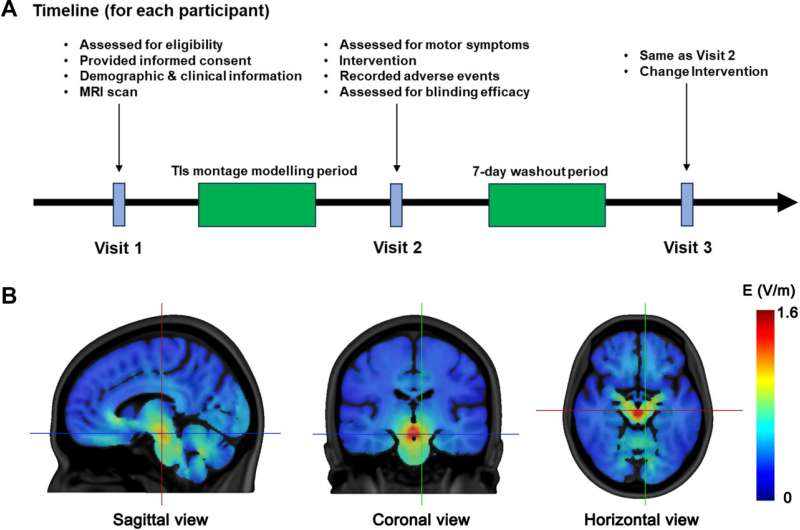
In the randomized, double-blind, crossover study, titled “Transcranial temporal interference stimulation targeting the subthalamic region for motor symptoms in Parkinson’s disease: a pilot, randomised, double-blind, sham-controlled crossover study,” 30 people with early- to mid-stage Parkinson’s disease received a single 20-minute session of individualized TIs targeting the subthalamic region—a key node in the brain’s motor control network—as well as a sham or placebo treatment in a separate session.