
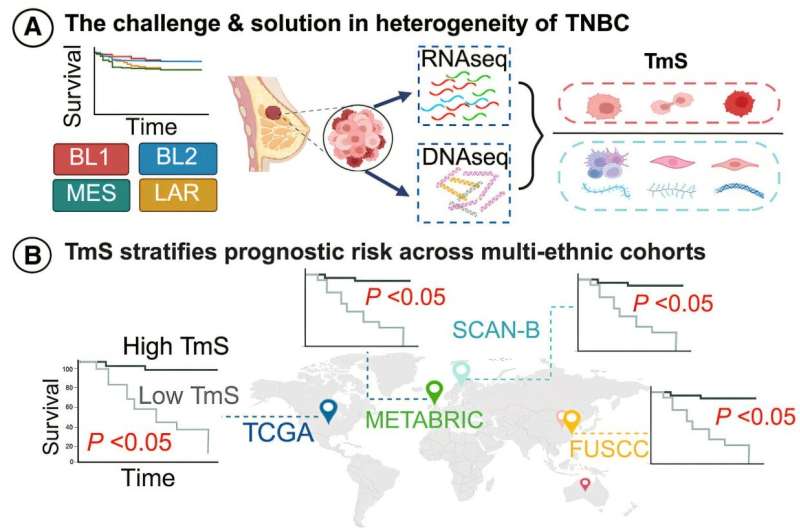
The new tool, developed by Wenyi Wang, Ph.D., professor of Bioinformatics and Computational Biology, and colleagues, was published today in Cell Reports Medicine. It aims to improve upon similar methods to predict treatment responses using an approach known as deconvolution, which involves breaking down, calculating and interpreting cellular differences. This approach also revealed novel insights into population-level characteristics of TNBC.
“Deconvolution strategies are not one size fits all,” Wang said. “We’re focused on making these methods more accessible to researchers without extensive computational backgrounds, with the goal of translating these powerful analytical approaches into practical tools that the broader cancer research community can readily apply to advance precision medicine.”